
Exploring Charles Bridge and Lesser Town (Malá Strana)
Riverside views, palace squares and old streets
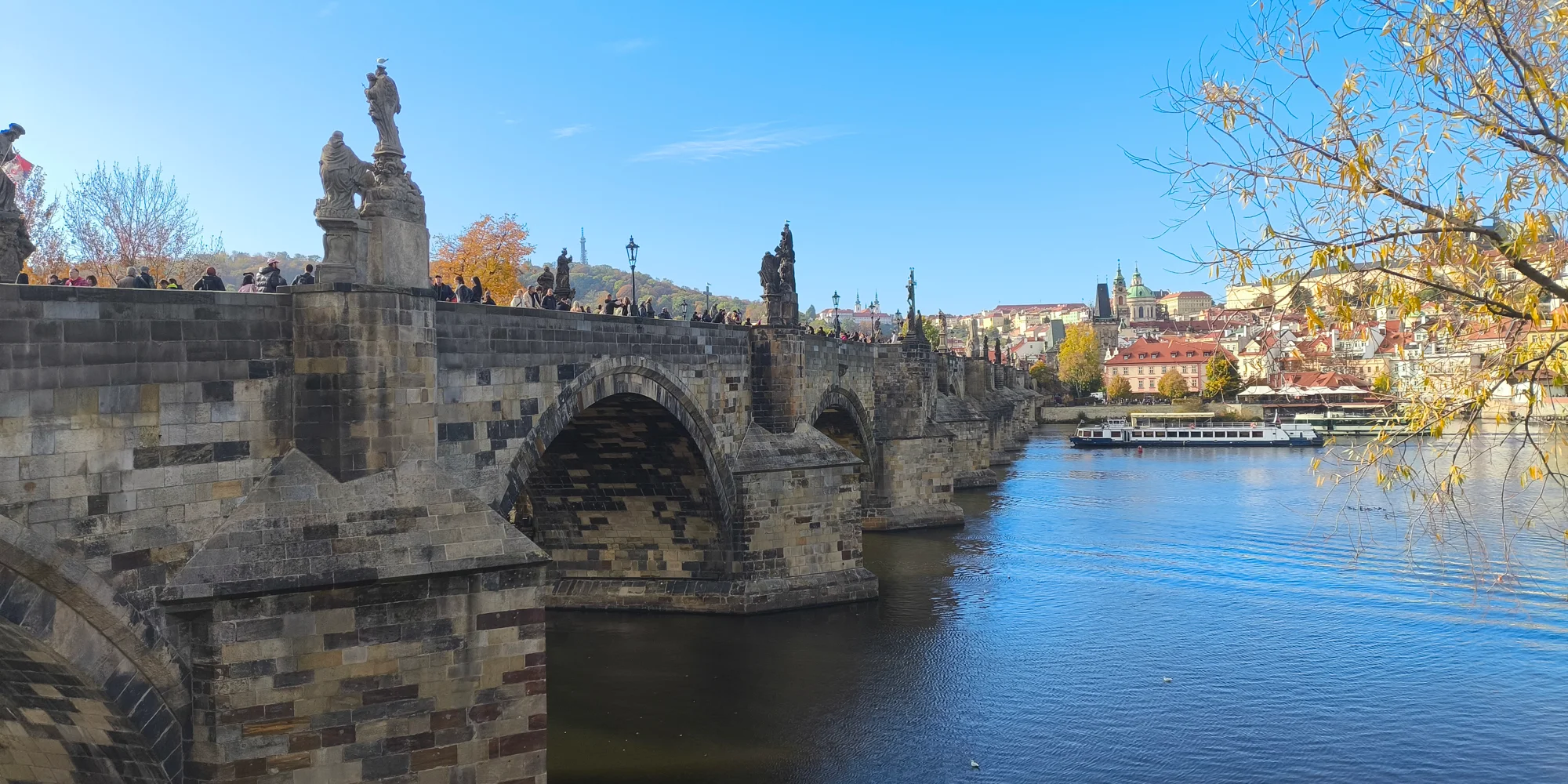
Cross Charles Bridge to Kampa, where you can pause for river views before crossing the Čertovka canal by the old mill wheel on your way to the Lennon Wall. Explore the streets below Prague Castle and follow Nerudova downhill to St Nicholas Church.
The optional Wallenstein Garden extension takes in its grand open hall, grotto wall and ornamental pond.
Estimated time: Around 2–3 hours for the main walk, plus 45–60 minutes for the optional Wallenstein Garden extension. Refreshment breaks and interior visits are additional.
Start: Křižovnické náměstí, beside the Old Town Bridge Tower.
Finish: Malostranské náměstí (Lesser Town Square), beside St Nicholas Church. The optional garden extension finishes near Malostranská metro and tram stops.
Cost: The core walk is free; optional paid visits and refreshments cost extra.
Before you start
Terrain: Cobbles, uneven paving, a short flight of steps near Charles Bridge and a longer climb up Jánský vršek. Nerudova descends towards the finish. Wear shoes with good grip, especially in wet weather.
Wallenstein Garden: The optional garden ending is seasonal. Check opening hours before setting out.
Water and toilets: Bring drinking water and a few Czech koruna coins for public toilets.
Weather: Charles Bridge is exposed. Bring sun protection in warm weather or a waterproof layer if rain is forecast.
Follow the shaded direction boxes as you walk. Select a stop in the route overview or a marker on a map to jump to its description. Each stop also links back to the overview and its relevant map.
Route overview
Follow the numbered stops in order. Select a circle or stop name to jump to the text. Wallenstein Garden is an optional extension after stop 8.
Maps: Full walk · Kampa and Čertovka · Palace squares and Nerudova · Wallenstein Garden
Full walk
Select a map marker to jump to its stop. Zoom in to read smaller labels.
Open full-size map ↗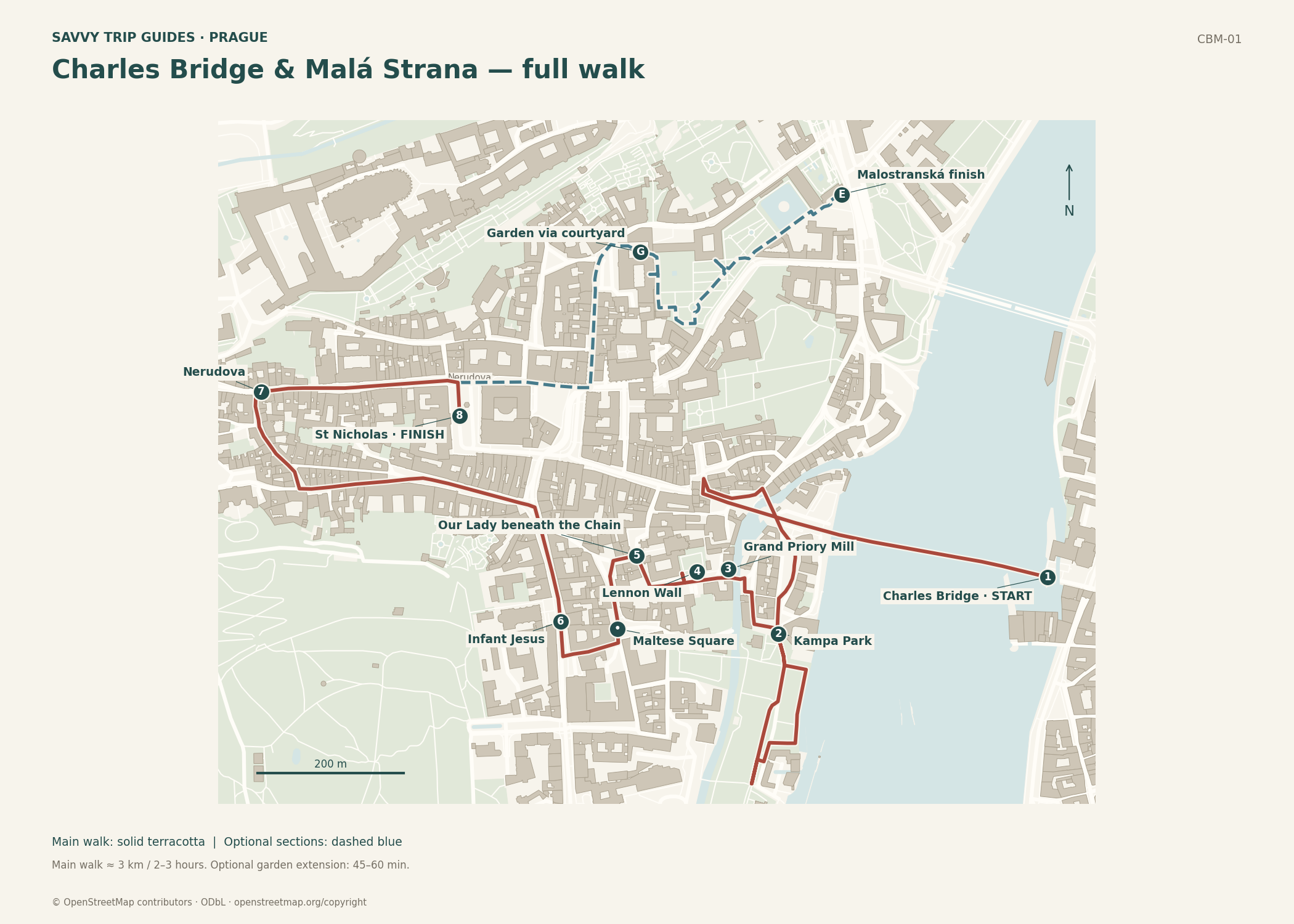
Charles Bridge
STOP AT A GLANCE
Optional visits: Paid climbs to the viewing galleries of either bridge tower.
Old Town Bridge Tower
Begin on Křižovnické náměstí, on the Old Town side of the tower.
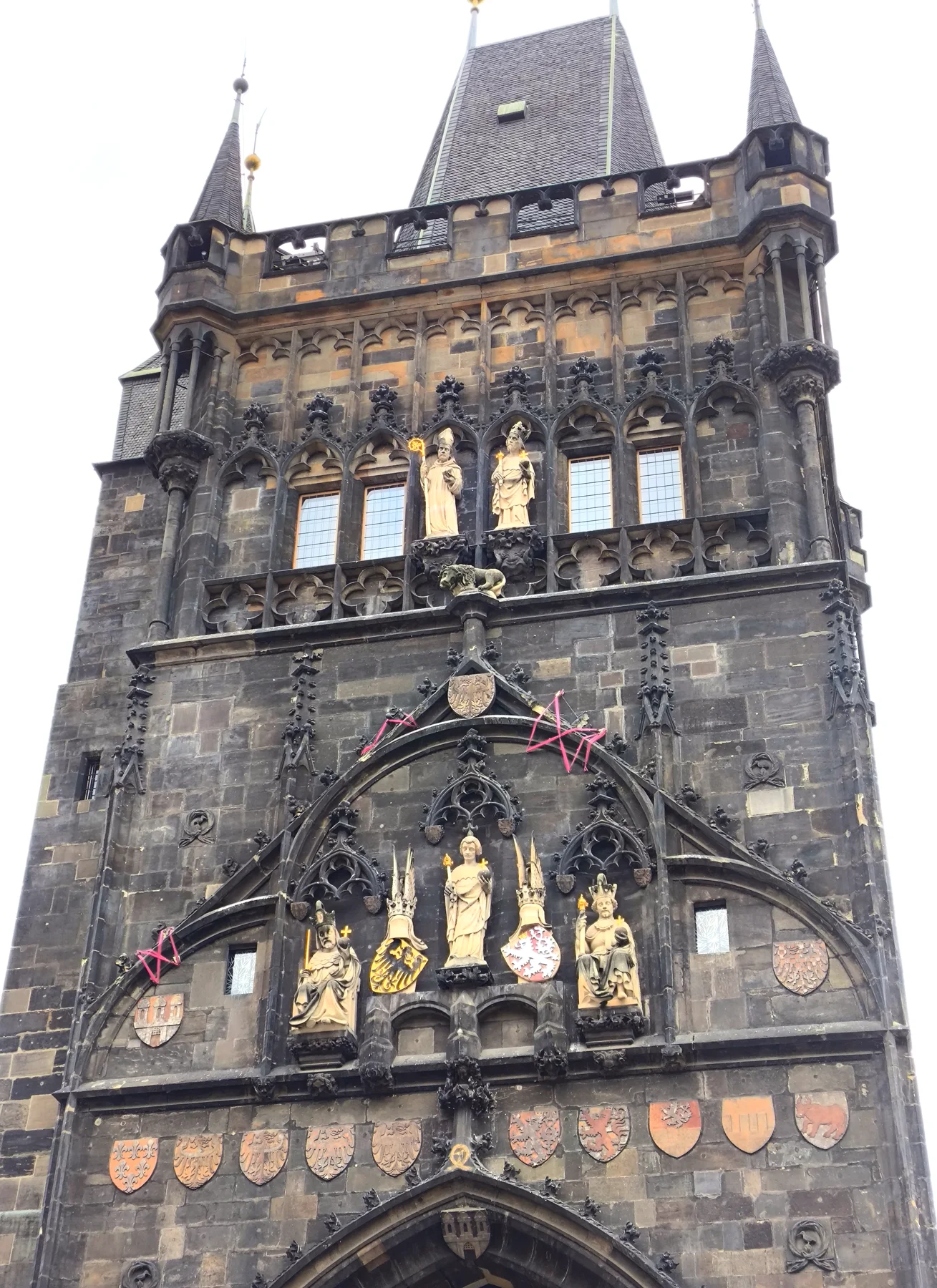
The Old Town Bridge Tower marks the entrance to Old Town from Charles Bridge. Travellers arriving from Malá Strana passed beneath its archway to enter the town; our walk takes us through it in the opposite direction, towards the river.
The Gothic tower was built in the later fourteenth century as part of Charles IV's new bridge. Charles himself appears among the sculptures on the Old Town side, seated beside his son Wenceslas IV. Between the two seated rulers, St Vitus stands on a model of the bridge, identifying him as its patron.
The decoration continues beneath the archway, where the painted vault includes Wenceslas IV's kingfisher emblem. Some of the painting was completed during nineteenth-century restoration, so what you see combines medieval decoration with later work.
On the bridge-facing side, the tower looks much plainer. It once had sculptures here too, but much of the decoration was destroyed during the Swedish attack on Prague in 1648. A Latin plaque added during the subsequent repairs commemorates the city's defenders.
Optional visit · Old Town Bridge Tower
Climb 138 steps to the viewing gallery for a view along the bridge towards Prague Castle. Suggested time: 30–45 minutes. Tower tickets and opening hours
Walk through the tower archway towards the river. From the Old Town end of the bridge, you get the best view of Prague Castle and Malá Strana.
Crossing Charles Bridge
Construction of Charles Bridge began in 1357 on the orders of Charles IV, replacing the earlier Judith Bridge after it was badly damaged by flooding in 1342. The crossing linked Old Town with Malá Strana and the approach to Prague Castle.
The bridge itself is medieval, but most of its sculptural decoration came much later. Thirty statues and sculptural groups line the bridge, many dating from the Baroque period. Many originals have since been replaced by replicas to protect them from further weathering.
As you cross, here are three of the sculptures to look out for, in the order you’ll reach them.
The Crucifix and Calvary
On your right, the third sculpture group is recognisable by its large cross and gilded Hebrew lettering.
The bronze figure of Christ on the cross is flanked by the Virgin Mary and St John the Evangelist. The group was assembled over time: the bronze Christ was placed on the bridge in 1657, while the stone figures beside him were added in 1861.
The gilded lettering around Christ is Hebrew and reads "Holy, holy, holy is the Lord of hosts." It was added in 1696, paid for through a fine imposed on a Jewish man, Elias Backoffen, who had been accused of insulting the cross.
The words are an important Jewish declaration of faith; placing them around the crucified Christ was intended to humiliate the Jewish community. In 2000, explanatory plaques were added to acknowledge the unfair court proceedings and the circumstances behind the inscription.
St John of Nepomuk
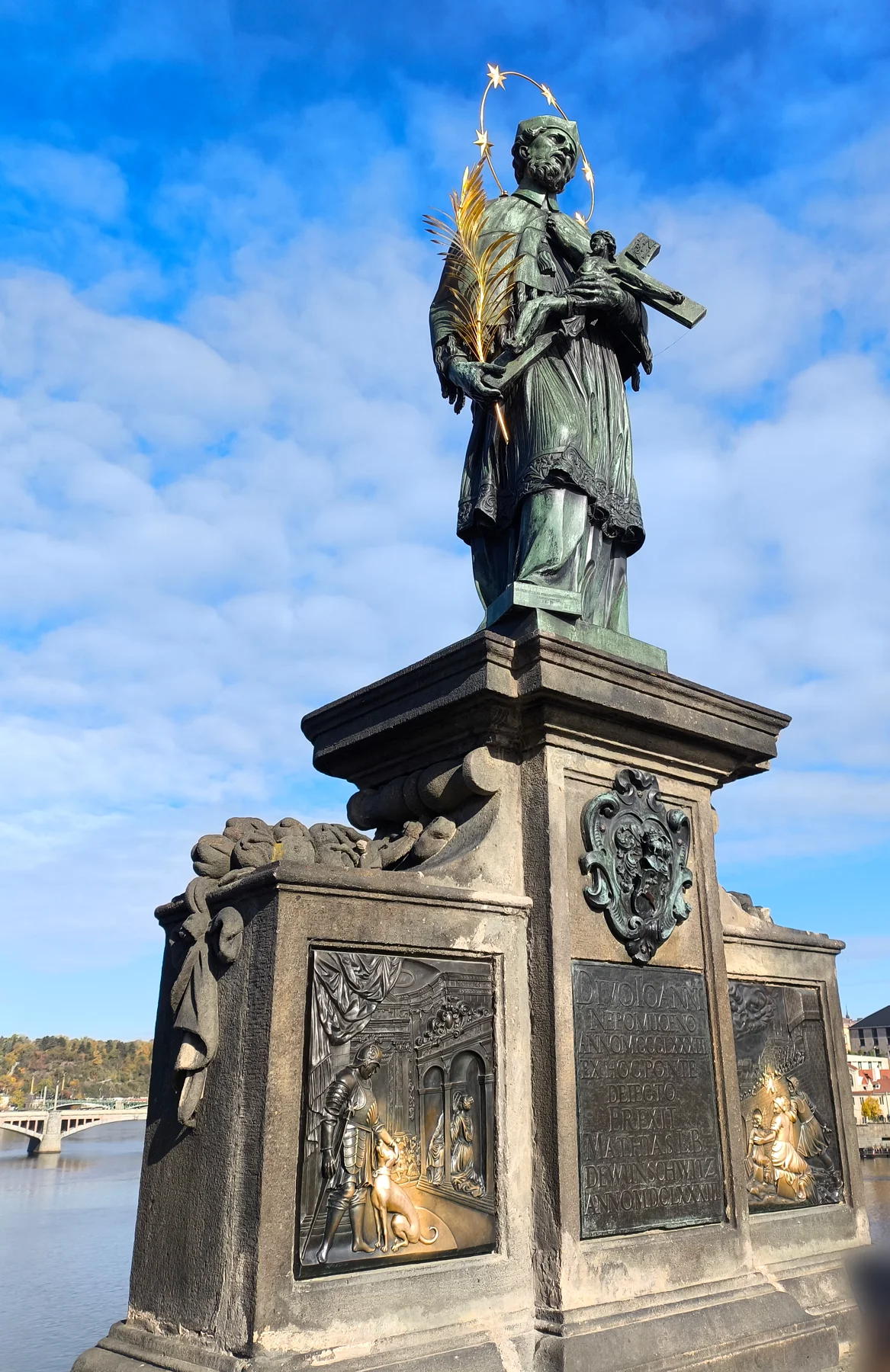
Farther along the bridge on your right is the bronze statue of St John of Nepomuk, recognisable by the five stars around his head.
John was a priest caught up in a struggle between King Wenceslas IV and the Archbishop of Prague. In 1393, he was tortured to death and his body was thrown from the bridge into the Vltava.
His death later became the subject of a legend: the king had ordered John to reveal the queen's confession, and John refused. Five stars were said to have appeared above the river when he was thrown from the bridge, which is why the statue has a five-star halo.
The statue has stood on the bridge since 1683. The bronze reliefs beneath it tell his story: the left-hand scene shows the queen's confession, while the right-hand scene shows John being thrown into the river.
Visitors touch the bronze reliefs beneath the statue because, according to a popular belief, doing so brings good luck and ensures a return to Prague. Repeated touching has polished parts of the bronze to a bright shine.
St Luthgard
Farther along the bridge on your left, look for a sculpture of Christ on the cross with a nun beside him. This is St Luthgard.
Carved by Matyáš Bernard Braun in 1710, this is one of the bridge’s outstanding Baroque sculptures.
The scene represents a vision experienced by the medieval Cistercian nun Luthgard. In her vision, Christ reached down from the cross, embraced her and drew her towards the wound in his side to kiss it. Braun shows that moment, with Christ's right arm freed from the cross and wrapped around her shoulders.
Lesser Town Bridge Towers
At this end of the bridge, two very different towers flank the gateway into Malá Strana, Prague's Lesser Town. The smaller one, Judith's Tower, survives from the days of the earlier Judith Bridge. Its core dates from the twelfth century, although the roof and decorative gables belong to a Renaissance remodelling in 1591.
The taller stone tower was begun in 1464 under King George of Poděbrady, replacing an older tower. Its pointed arches and steep roof echo the Old Town Bridge Tower at the other end of the crossing. But here the recesses intended for statues remain empty: the planned sculptural decoration was never installed.
Between them, the gateway is topped with battlements and carved coats of arms. From the archway, Mostecká Street leads into the heart of Malá Strana.
Optional visit · Lesser Town Bridge Tower
The taller tower has a viewing gallery overlooking the bridge and the rooftops of Malá Strana. Suggested time: 30–40 minutes. Tower tickets and opening hours
At the Malá Strana end of Charles Bridge, turn right just before the gateway, directly in front of the right-hand tower. Look for a short flight of steps on your right.
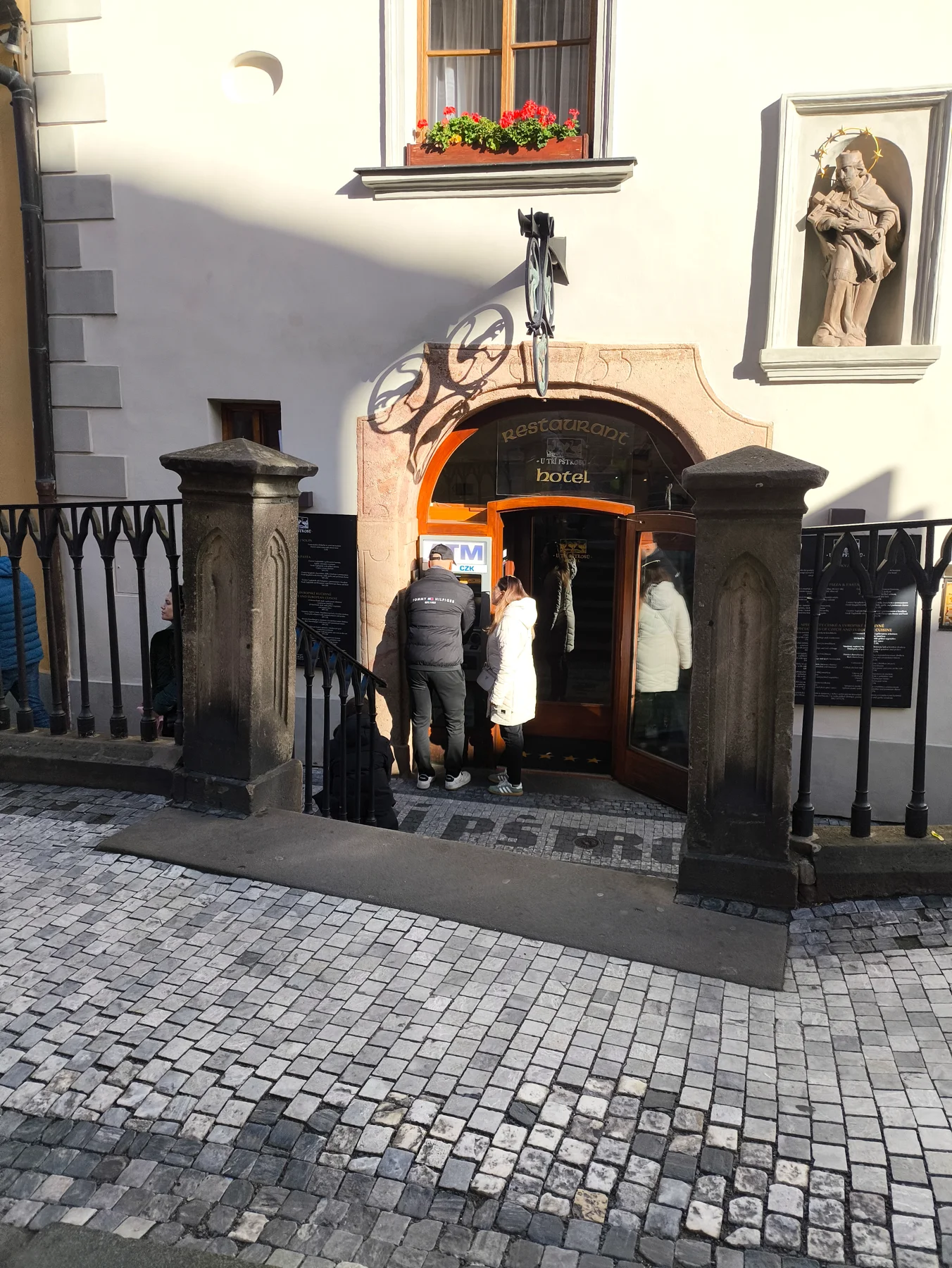
Go down the steps and turn right again. Follow the lane downhill towards the Čertovka canal, keeping Charles Bridge on your right. At the third arch of Charles Bridge, cross the small bridge over the canal, then pass beneath Charles Bridge. Pause to enjoy the views on both sides of the bridge. You are now on Kampa Island.
Kampa and Čertovka
Select a map marker to jump to its stop. Zoom in to read smaller labels.
Open full-size map ↗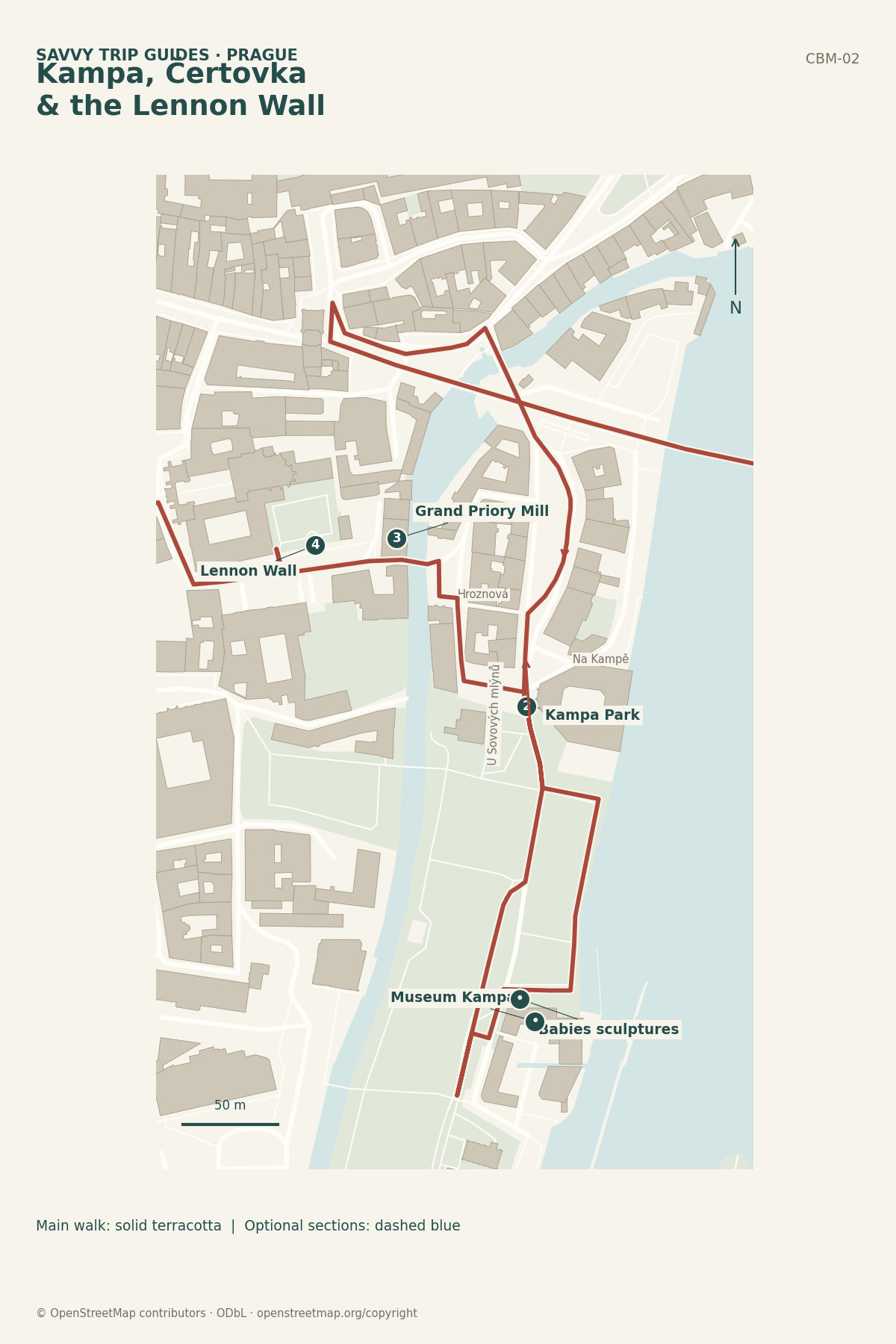
Kampa Square and Park
STOP AT A GLANCE
Facilities: Public toilets in Kampa Park.
Optional visit: Museum Kampa, an art museum on the Vltava riverbank. Museum visit: about two hours.
The Čertovka canal, whose name is usually translated as “Devil’s Stream”, separates Kampa Island from the rest of Malá Strana and once powered mills along its banks. Museum Kampa occupies the former Sovovy mlýny mill complex on the Vltava riverbank.
The houses around Na Kampě once looked onto a pottery market. Shoppers came from across Prague for painted plates, jugs and even ceramic animals. As you cross the square, look above the doorway at No. 1 for the blue fox that gives the house its name.
With Charles Bridge behind you, walk through the square and continue along the street towards the trees ahead, where Kampa Park begins. Follow the path straight ahead for about 200 metres to the three bronze babies near Museum Kampa. From there, head left towards the river for a view across the Vltava.
The three bronze babies beside Museum Kampa were created by David Černý and are related to the figures crawling up Prague’s Žižkov Television Tower. If the museum courtyard is open, you can also pop in to see the outdoor artworks.
Coffee nearby
A little farther along the Vltava riverbank, beyond the museum complex, the café at Skautský institut v Rybárně (Scout Institute) is an option for a coffee break. Open daily, 10:00–23:00.
Retrace your steps to the park entrance. Once back on the street, turn left towards the Kampa Garden Hotel and follow the street around the bend to the right into a small square. Bear left across the paved area towards the canal. Step onto the small footbridge for a close look at the mill wheel.
Čertovka and the Grand Priory Mill
From the footbridge, you can see the Grand Priory Mill’s large wooden waterwheel, which still turns at times. The wheel is a replica and no longer powers machinery, but it shows how flowing water once drove millstones to grind grain into flour. Beside it sits Kabourek, a bronze water spirit from Czech folklore, created by sculptor Josef Nálepa.
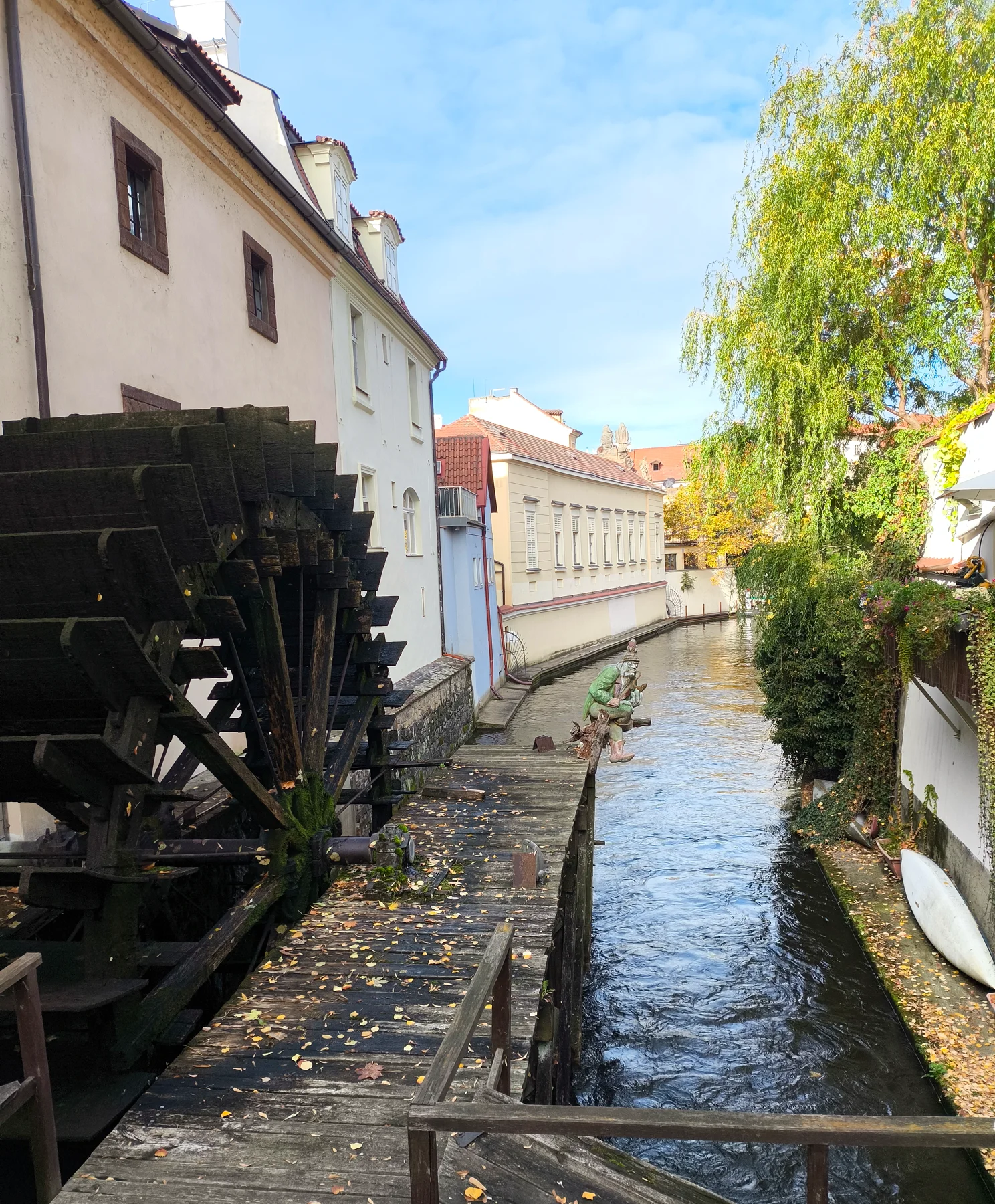
Cross the footbridge and follow the short passage between the buildings into the square beyond. Head diagonally across the square and slightly uphill to your right. Look for the colourful Lennon Wall behind the trees.
Lennon Wall and Grand Priory Square
After John Lennon was killed in 1980, people began leaving flowers, candles and messages here. The tribute became a place to speak out under Czechoslovakia’s communist regime. The authorities painted over the messages, but people came back and wrote them again. Its appearance continues to change.
The wall encloses the garden of the Grand Priory Palace, which belongs to the Knights of Malta—the order associated with the church we’ll visit next. Across the square stands Buquoy Palace, home to the French Embassy since 1919.
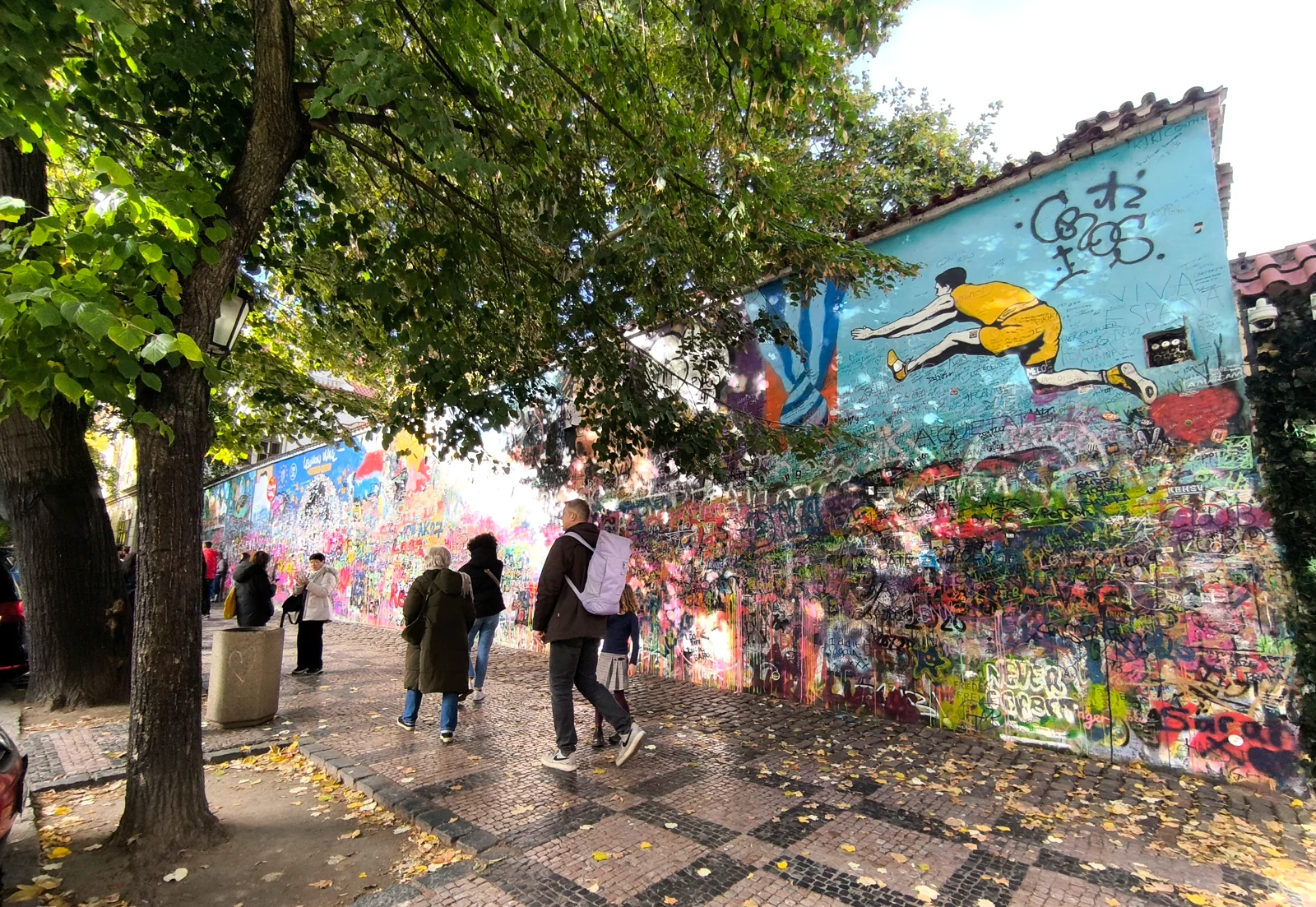
Continue uphill through the square and turn right into Lázeňská. After a few metres, look for the grand entrance to the Knights of Malta commandery on your right: a pointed gateway flanked by two massive stone towers.
Palace squares and Nerudova
Select a map marker to jump to its stop. Zoom in to read smaller labels.
Open full-size map ↗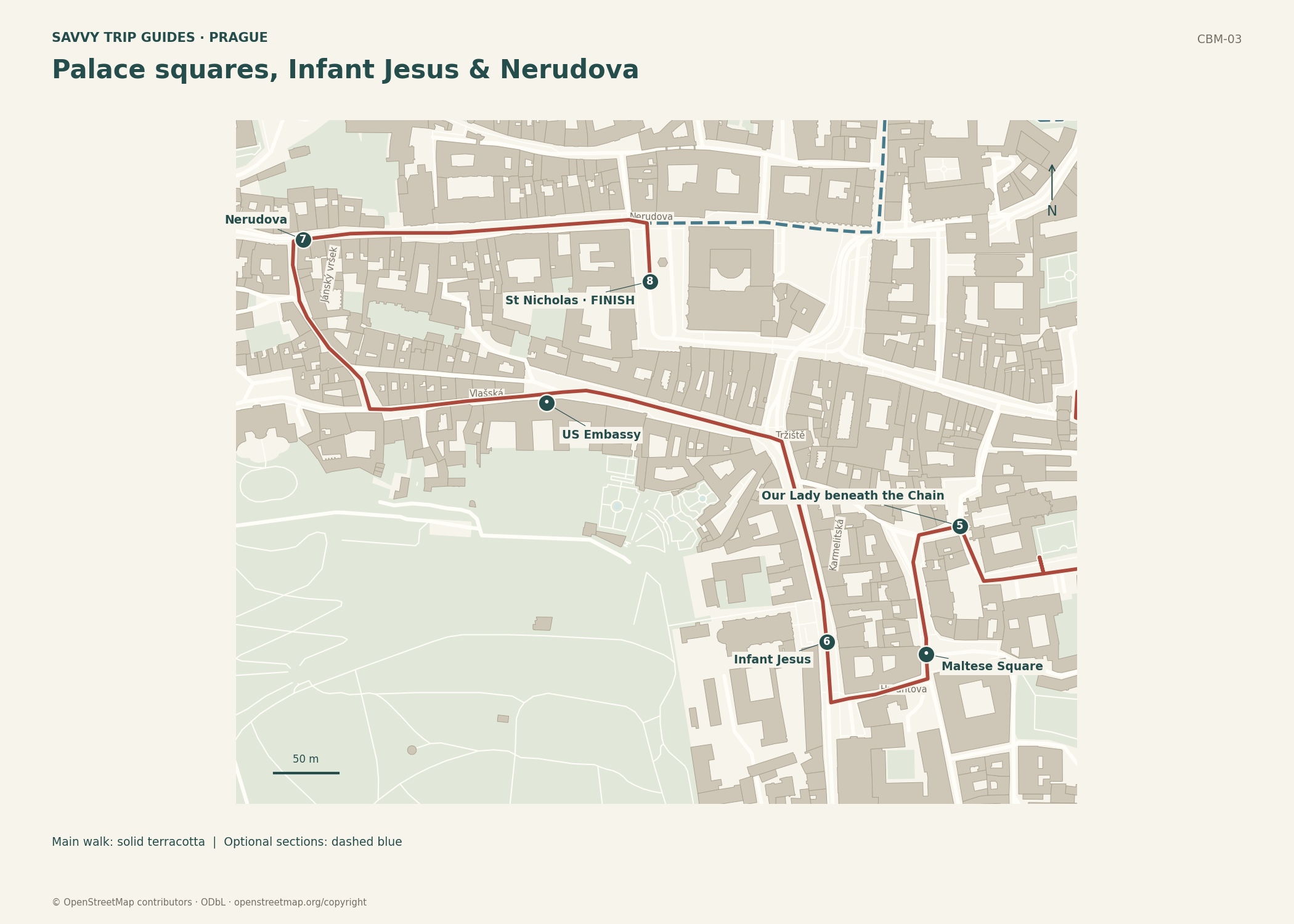
Our Lady beneath the Chain and Maltese Square
STOP AT A GLANCE
Access: Courtyard access depends on the gate being open. Full church interior visits are by prior arrangement.
The Knights Hospitaller, later known as the Knights of Malta, settled here in the twelfth century near Judith Bridge, the predecessor of Charles Bridge. The two towers formed the frontage of an ambitious Gothic church that was never completed. The courtyard beyond occupies the space intended for its nave.
If the gate is open, step into the courtyard. The church itself is at the far end, where you may be able to look through the grille into its Baroque interior.
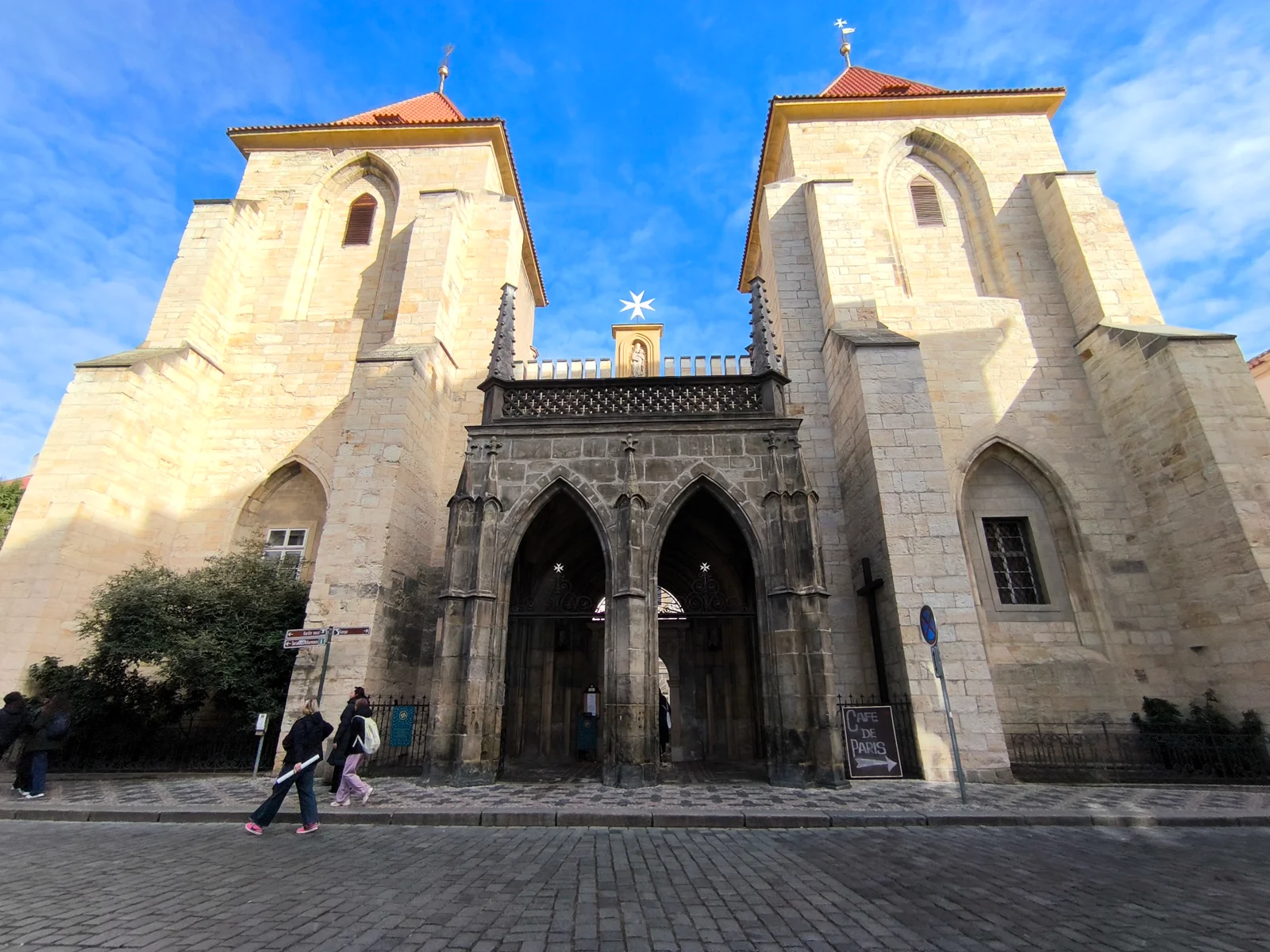
With your back to the gateway, walk towards the statue on the tall pedestal ahead.
The statue shows St John the Baptist, patron saint of the Knights of Malta. It was erected in 1715 in thanksgiving for the end of a plague outbreak and once stood at the centre of a fountain.
At the statue, follow the street to its left until it opens into the wider part of Maltese Square.
Here, look for the statues of Roman emperors along the roofline of Baroque Nostitz Palace, now home to the Czech Ministry of Culture.
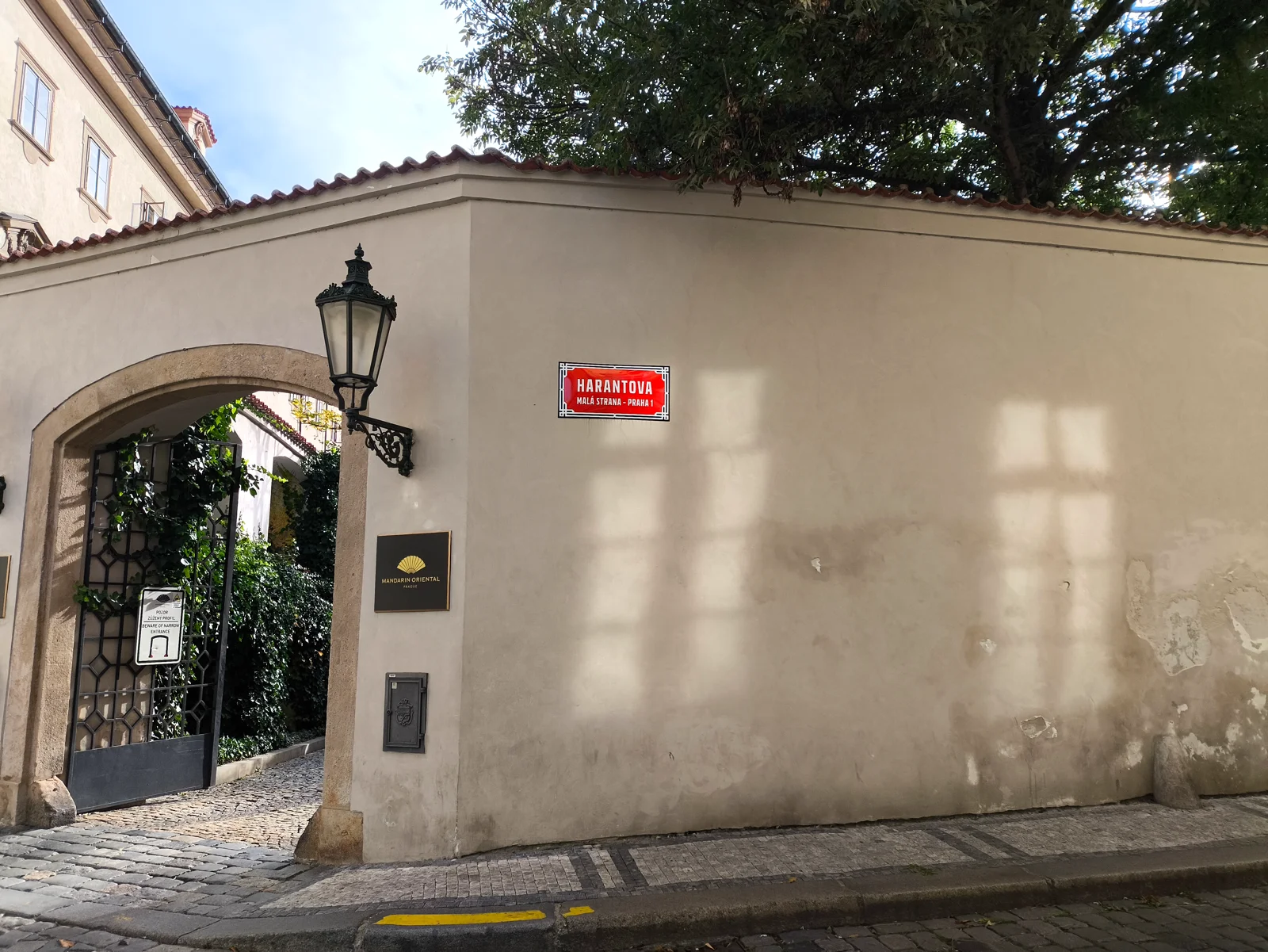
Cross to the far side of the square and turn right onto Harantova. At the end, you’ll reach Karmelitská, the main street with tram tracks. Use the traffic lights to cross, then turn right and follow Karmelitská towards the dome of St Nicholas in the distance. After about 70 metres, you’ll reach the Church of Our Lady Victorious.
Our Lady Victorious and the Infant Jesus of Prague
STOP AT A GLANCE
Optional visit: The church and robes museum; admission to both is free. Sightseeing visits take place outside service times.
Access: A spiral staircase leads to the robes exhibition.
Facilities: Public toilets at the church complex.
You can enter the Church of Our Lady Victorious to see the Infant Jesus of Prague, a small statue brought from Spain in the sixteenth century and donated to the Carmelites by the noblewoman Polyxena of Lobkowicz in 1628.
Believers associate the Infant Jesus with miracles and answered prayers. Pilgrims come from around the world to ask for help or give thanks, often bringing gifts of robes and jewellery.
The statue’s robes change with the church seasons. Some are richly embroidered and decorated with lace. The small museum displays a selection, including a robe donated by Empress Maria Theresa and a crown presented by Pope Benedict XVI during his visit in 2009.
Its international connections continue today: in September 2026, a blessed replica was presented to the Diocese of Kerry in Ireland as a gift from Prague.
Church and museum visitor information →
Coffee nearby
Café Knoflík is a cosy, traditional-style Czech café where you order at the counter as you enter. It’s about 300 metres in the opposite direction along Karmelitská—turn left after the crossing. Afterwards, return along Karmelitská towards the church.
Lunch nearby
Ferdinanda Malostranská is a welcoming Czech pub serving traditional dishes at reasonable prices. Its weekday lunch menu offers a short selection of daily dishes. It’s on the opposite side of Karmelitská from the church, farther along towards St Nicholas and Lesser Town Square. Go through the building’s main entrance into the passage leading towards the inner courtyard. The restaurant door is on your right within this passage, with steps leading down to the basement restaurant.
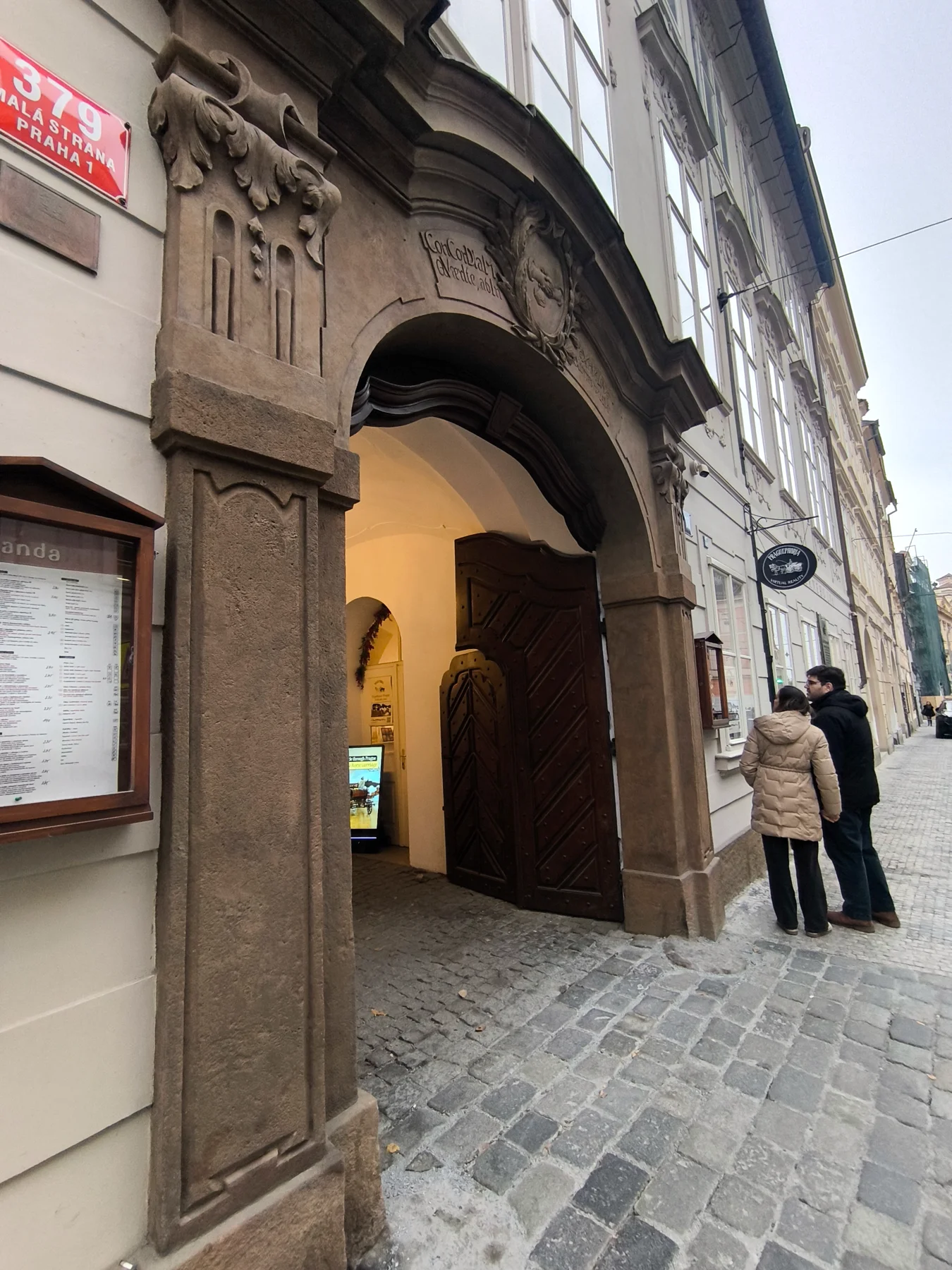
Continue along Karmelitská towards the dome of St Nicholas. Turn left into Tržiště.
Wandering Malá Strana’s Streets and Lanes
STOP AT A GLANCE
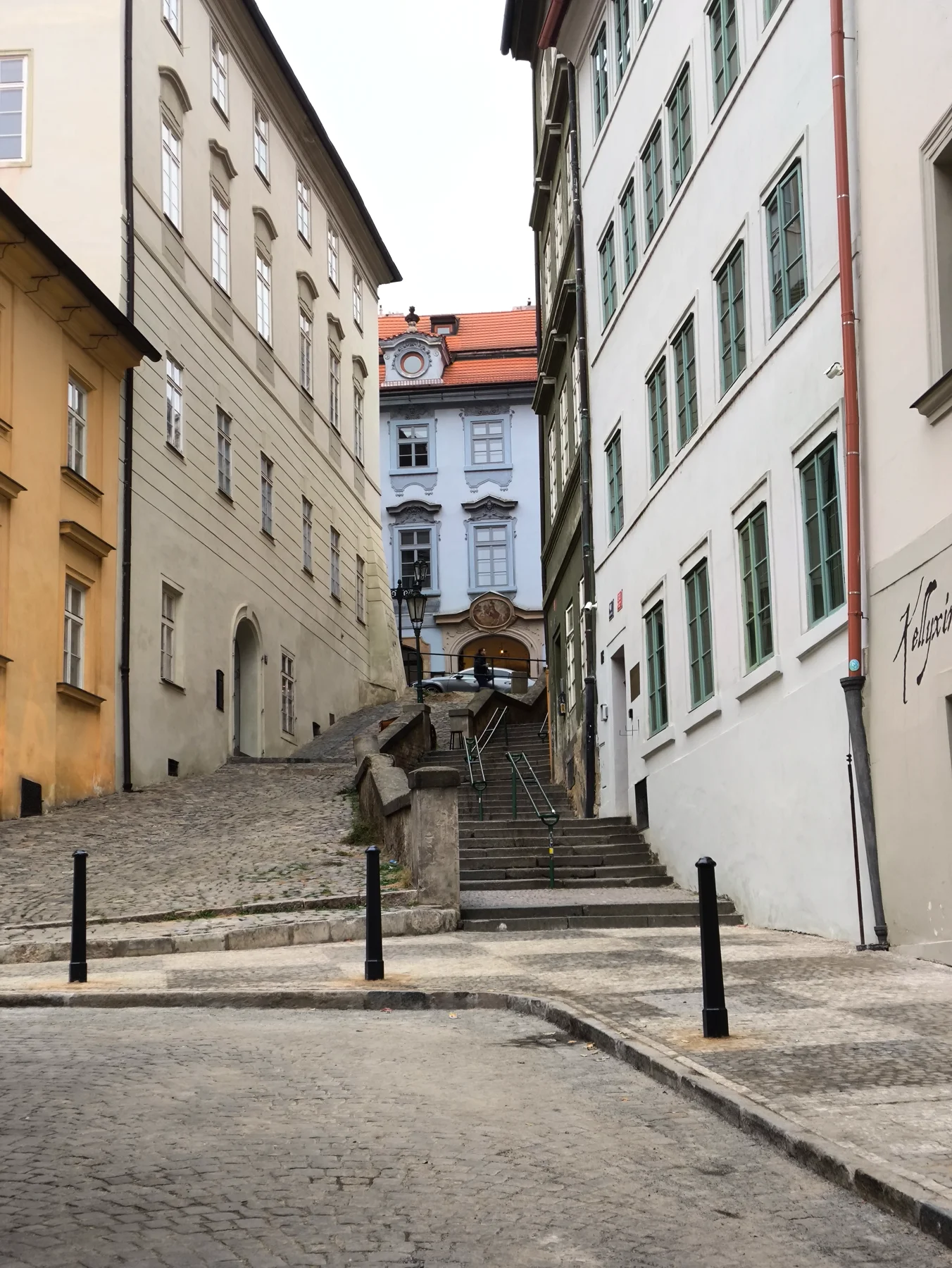
Terrain: An uphill section through Vlašská and Jánský vršek, followed by a long flight of steps to Nerudova.
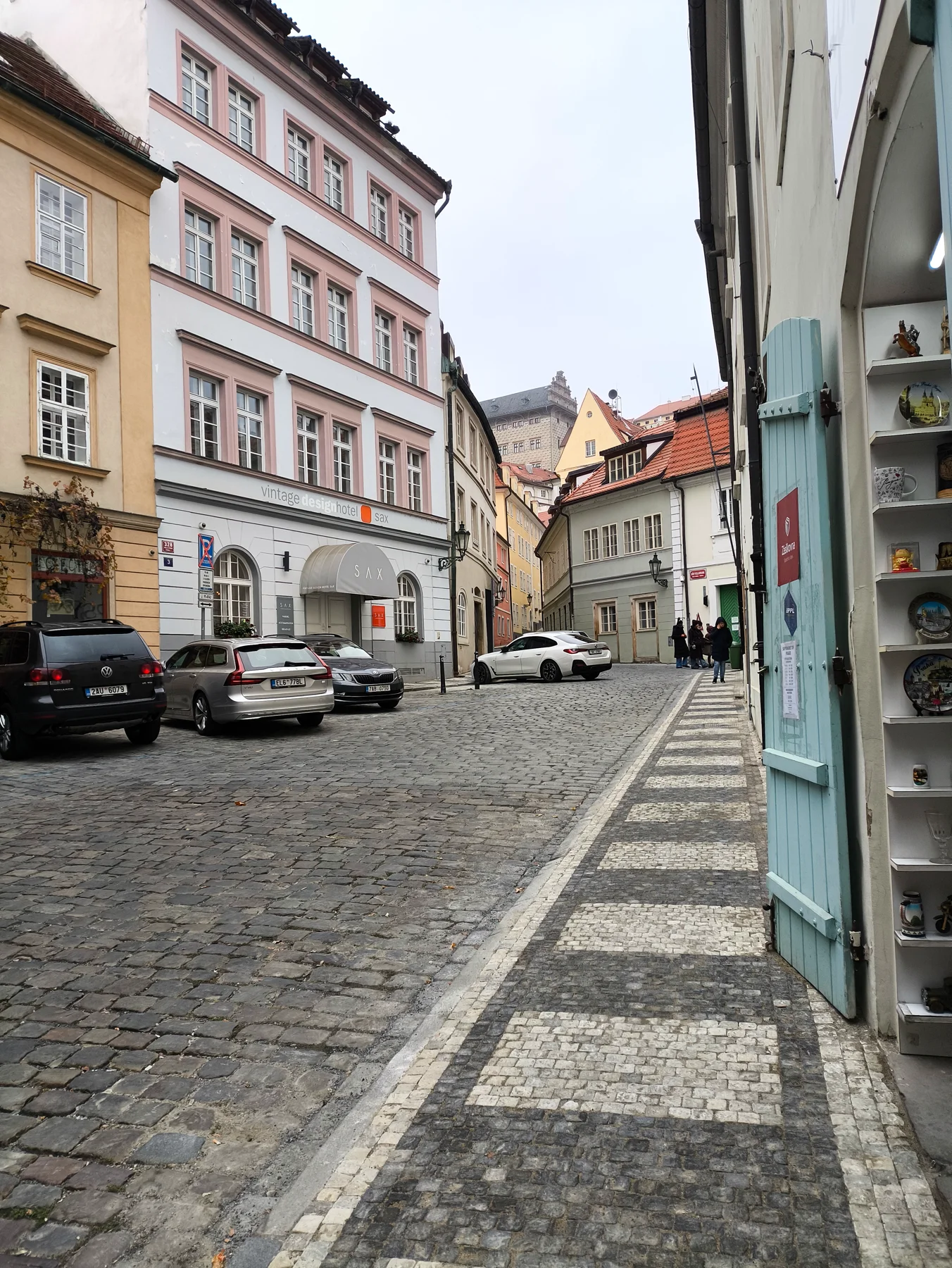
This part of the walk explores a quieter corner of Malá Strana, with old houses and palaces lining the lanes. You’ll pass the US Embassy, which explains the more visible security nearby. On Nerudova, the bustle returns: souvenir shops and restaurants line this busy route towards Prague Castle. Our walk follows it downhill towards Lesser Town Square.
Where the street divides, follow the branch that continues in front of the US Embassy, onto Vlašská. Continue until the street opens into a wider area on your right. Turn right into this area, walk to the far end, then take Jánský vršek on the left. Follow it to the long flight of steps leading up to Nerudova.
Down Nerudova
At the top of the steps, look directly across Nerudova for the blue house At the Golden Horseshoe. Painted on its façade is St Wenceslas riding a white horse, with a small golden horseshoe on the horse’s front hoof. The Baroque façade probably dates from a rebuilding in the 1720s.
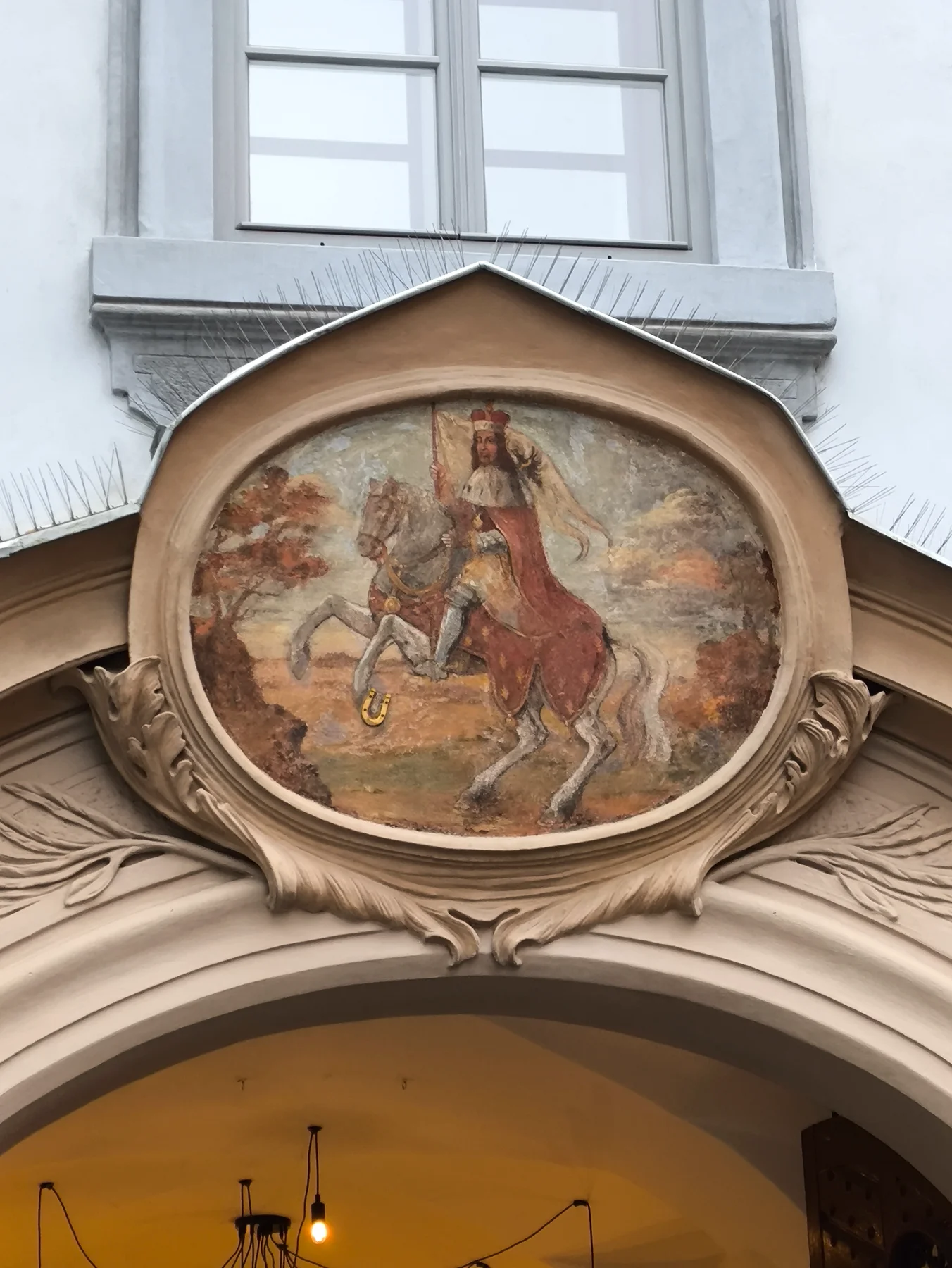
In a local tale, an old woman knocked one night asking for shelter. After the owner took her in, black eggs appeared in the kitchen, strange noises echoed through the house and figures danced on the roof. With a horseshoe in his pocket for protection, he went to ask her to leave. She had vanished, leaving behind money that smelled of hell. He gave it to local orphans and hung the horseshoe above his door. And that, according to local legend, is how the house got its name.
Turn right and follow Nerudova downhill towards Lesser Town Square.
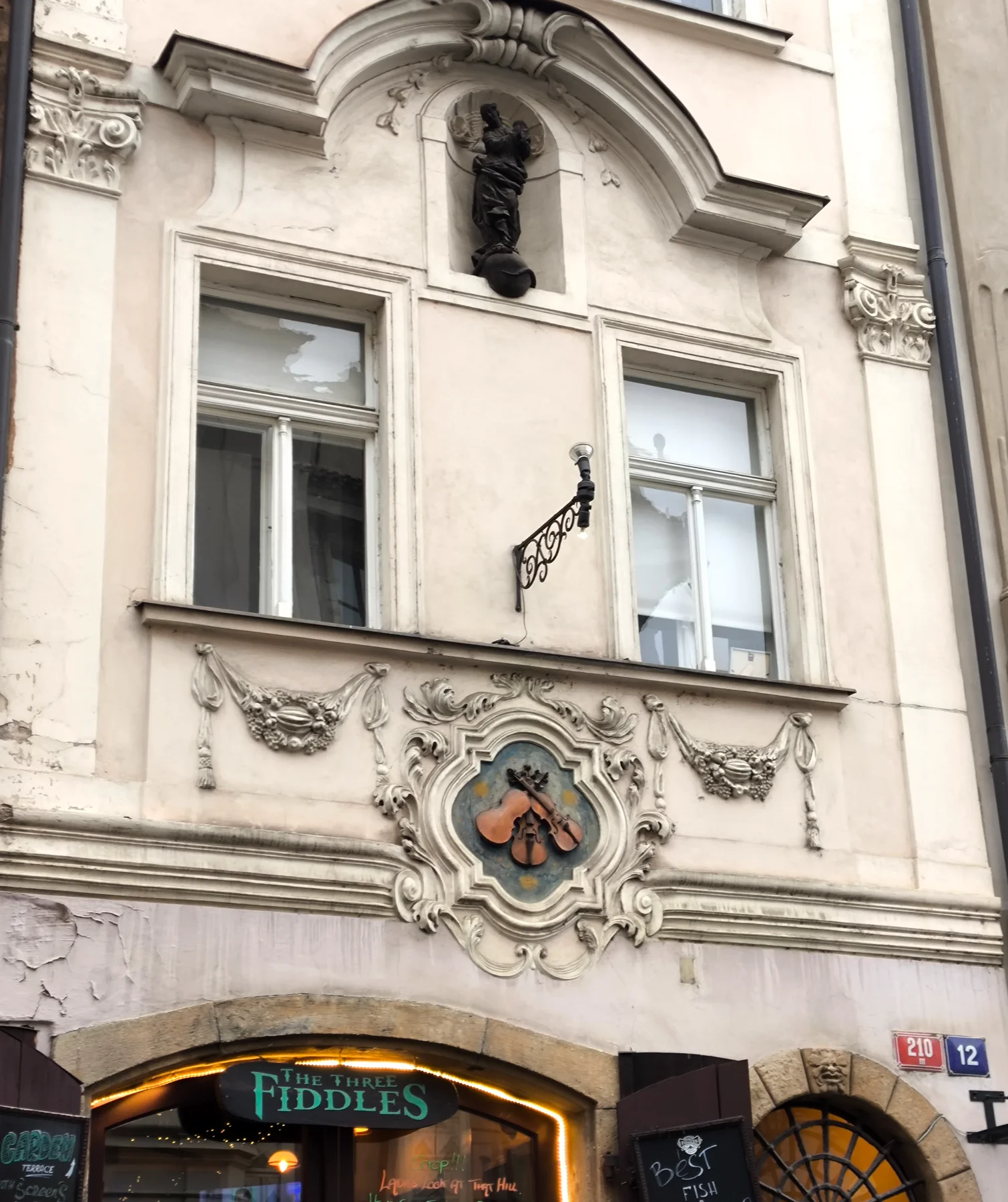
Along the way, look above the shopfronts for other house signs, including the Three Violins, recalling the violin makers who lived and worked here.
Farther downhill, Morzin Palace, now the Romanian Embassy, stands out for the two monumental sculpted figures supporting its balcony. They were carved by Ferdinand Maxmilián Brokoff.
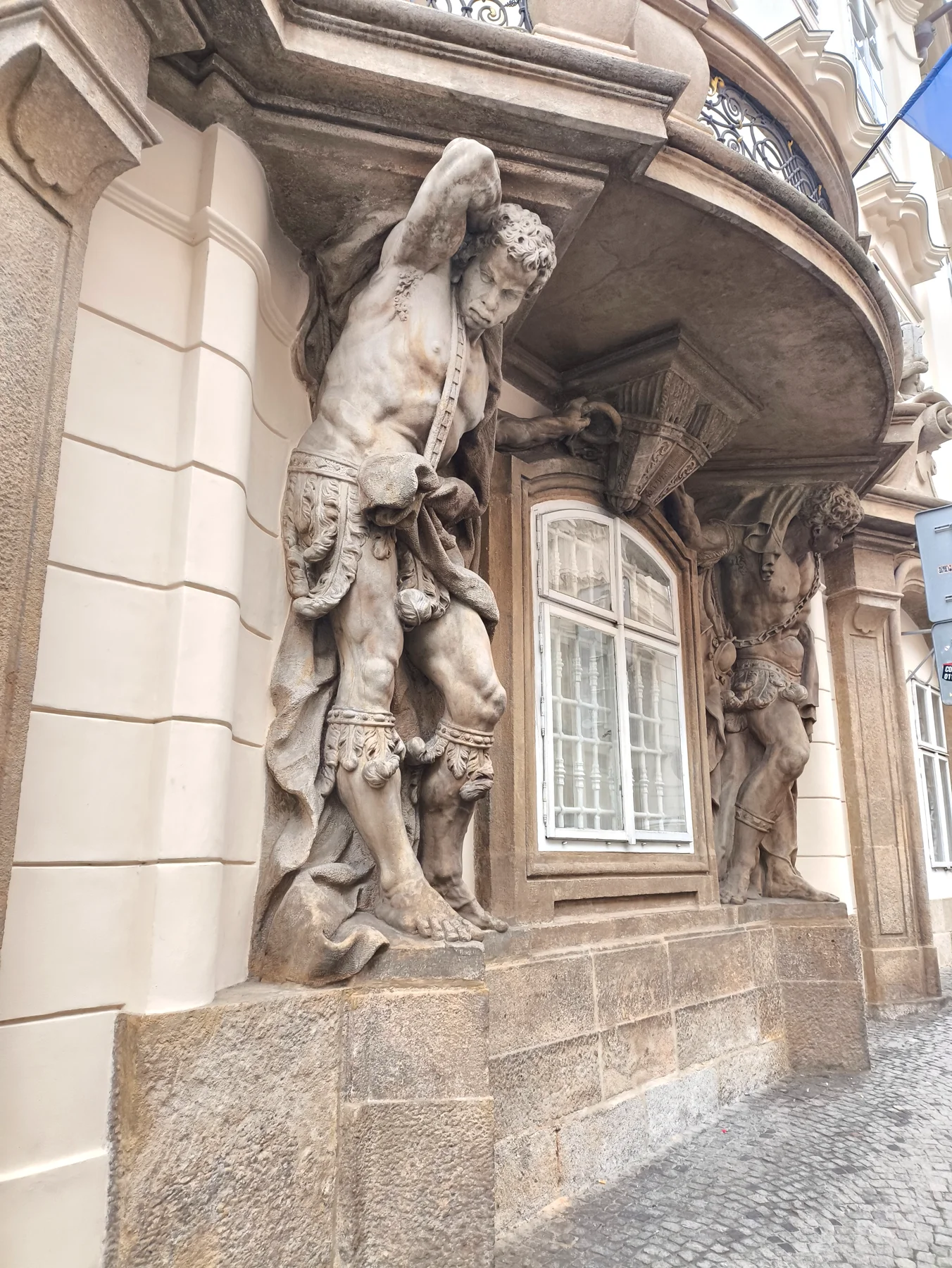
Lesser Town Square and St Nicholas Church
STOP AT A GLANCE
Optional visits: St Nicholas Church interior and the bell tower are separate paid visits, with separate entrances and tickets.
Access: The bell-tower gallery is reached by 215 steps.
Onward travel: Trams and bus 194 depart from the square.
At the bottom of Nerudova, you’ll reach Lesser Town Square (Malostranské náměstí) and St Nicholas Church, the final stop of the main walk.
St Nicholas is one of Prague’s great Baroque churches. Built for the Jesuits in the eighteenth century, it was shaped by two generations of the Dientzenhofer family: Kryštof designed the nave, while his son Kilián Ignác designed the chancel and great dome. The richly decorated exterior gives a taste of the elaborate interior, which you can visit separately.
The dome and neighbouring bell tower form a familiar silhouette, but the tower belonged to the town rather than the church. The Lesser Town coat of arms above its separate entrance marks that distinction.
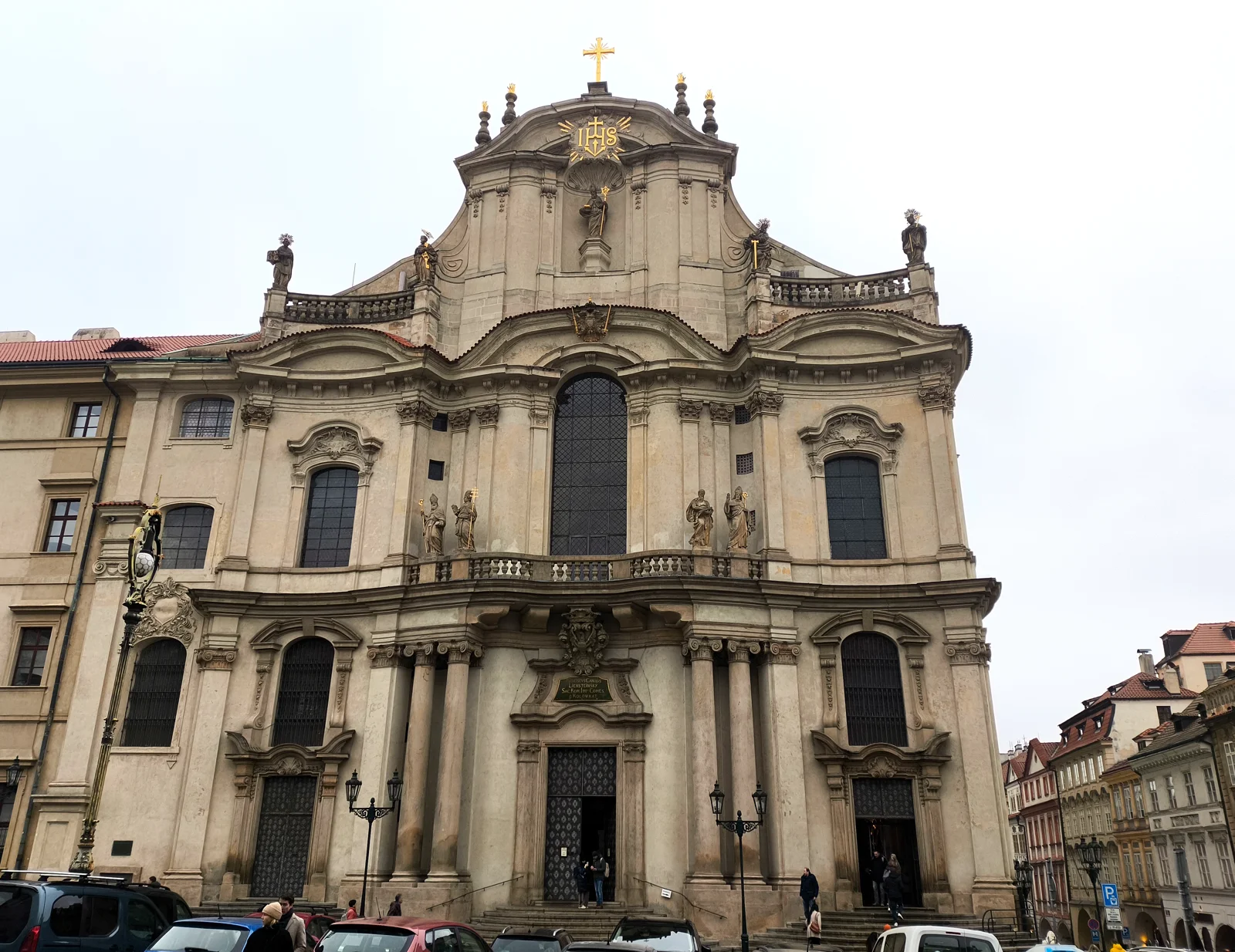
Optional visit · St Nicholas Church
Step inside for the richly decorated Baroque interior, with ceiling frescoes, sculptures and the soaring space beneath the dome. Church tickets and opening hours →
Optional visit · St Nicholas Bell Tower
Climb to the viewing gallery for a close view of the dome and the rooftops of Malá Strana. The tower also contains the former watchman’s rooms and an exhibition about its later use by the communist secret police to monitor nearby embassies. Bell-tower tickets and opening hours →
Onward travel
There’s a tram stop on the square. To head up to Prague Castle, take tram 22 towards Bílá Hora and get off at Pražský hrad. From there you can pick up our Prague Castle & Hradčany walk.
Returning to Old Town: Follow Mostecká from the lower part of the square to Charles Bridge, then cross the river into Old Town. Alternatively, take bus 194 towards Florenc from Malostranské náměstí and get off at Staroměstské náměstí, by Old Town Square. It runs roughly every 15 minutes on weekdays and every 30 minutes at weekends during the daytime. Check the next departure in PID Lítačka, particularly at weekends when services are less frequent.
Wallenstein Garden
Select a map marker to jump to its stop. Zoom in to read smaller labels.
Open full-size map ↗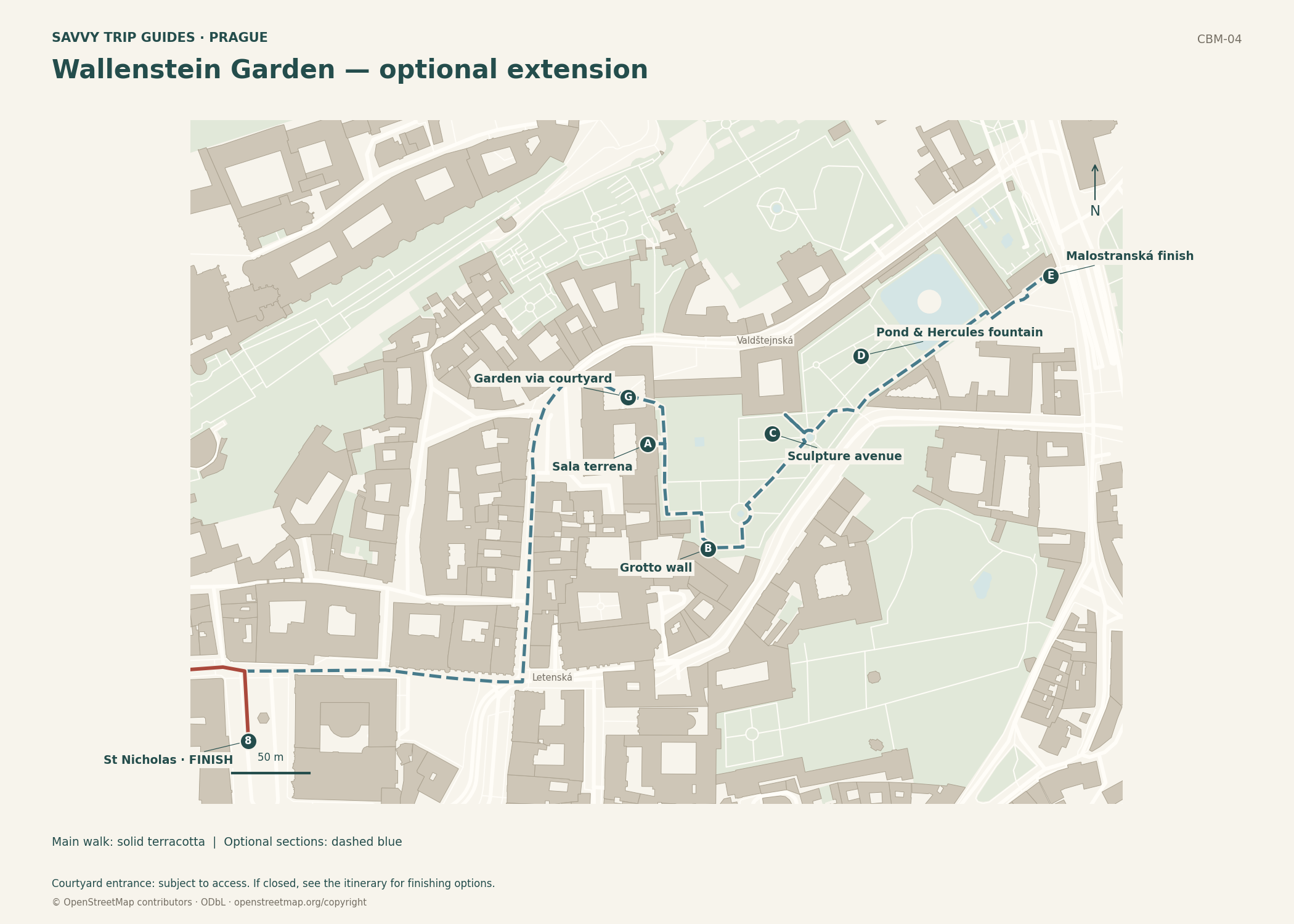
Wallenstein Garden
Optional extension · 45–60 minutes · seasonal opening
STOP AT A GLANCE
Facilities: Paid toilets in the garden.
Head to the upper end of the square and follow the pavement under the arches of Sternberg Palace onto Tomášská. Follow the street as it bends right into Wallenstein Square. Look for the long frontage of Wallenstein Palace.
Wallenstein Palace
Wallenstein built this enormous early Baroque palace in the 1620s, during the Thirty Years’ War. An imperial commander, he had become one of Bohemia’s wealthiest noblemen, acquiring vast estates confiscated after the defeat of the Bohemian rebellion in 1620.
Wallenstein barely enjoyed his grand residence: although it was completed around 1630, he spent less than a year here before his assassination in 1634. The palace was confiscated, then bought by a relative, whose family retained it until 1945. It now houses the Senate, the upper chamber of the Czech Parliament.
Continue along the palace frontage to the third entrance—the farthest along as you approach. If the gate is open, go through into the courtyard, then take the steps down into the garden.
If the courtyard gate is closed, you can either return to Lesser Town Square and finish the walk there, or follow Valdštejnská around the outside of the garden to Malostranská metro station and the nearby tram stops.
The sala terrena
The garden opens out in front of the sala terrena, a grand open-sided hall with three towering arches. Wallenstein used it to receive guests. Its painted ceiling brings classical gods into the setting of his palace garden.
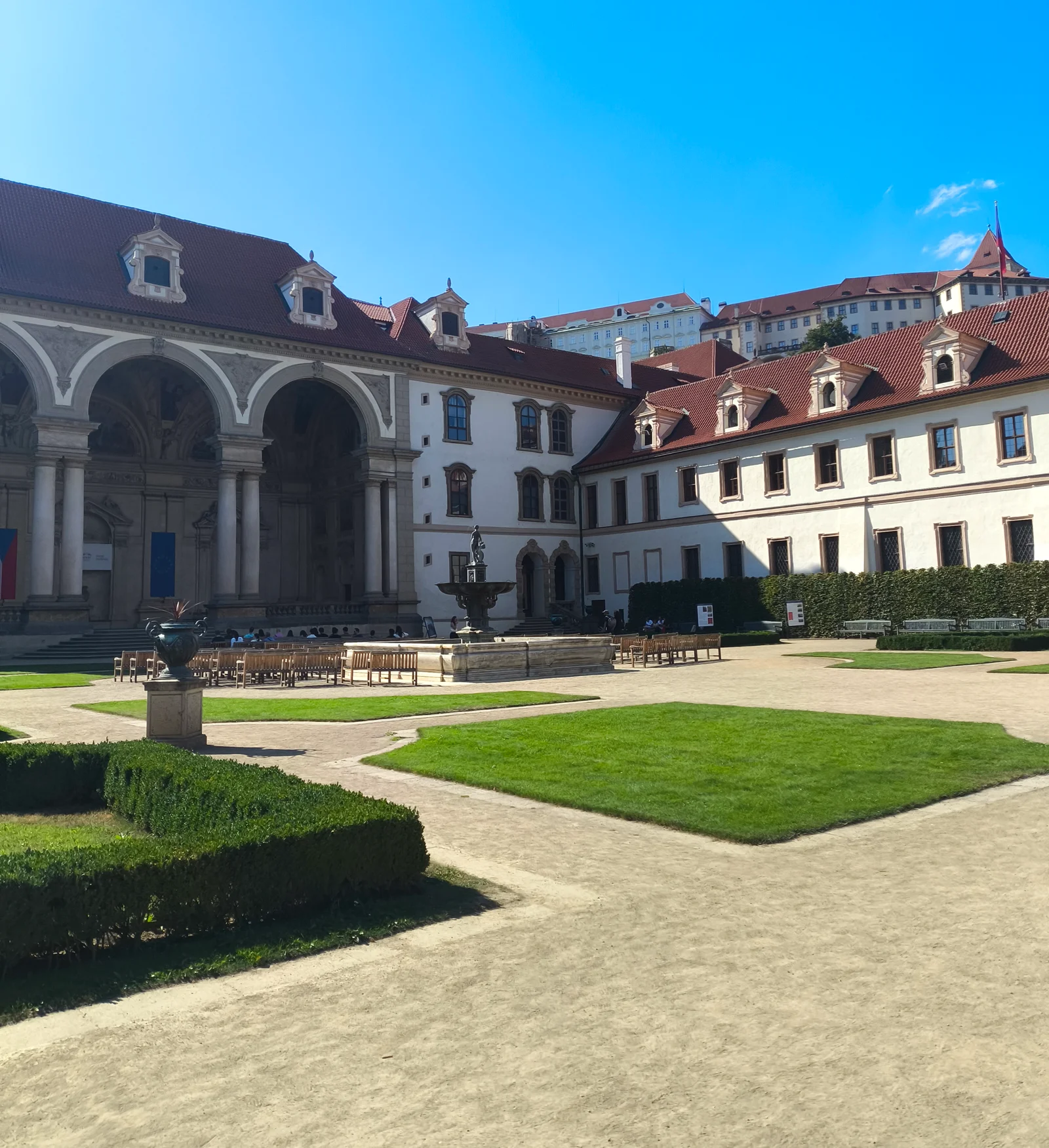
Cross the width of the garden towards the side opposite the courtyard entrance you used. The grotto wall is partly hidden behind the trees on that side.
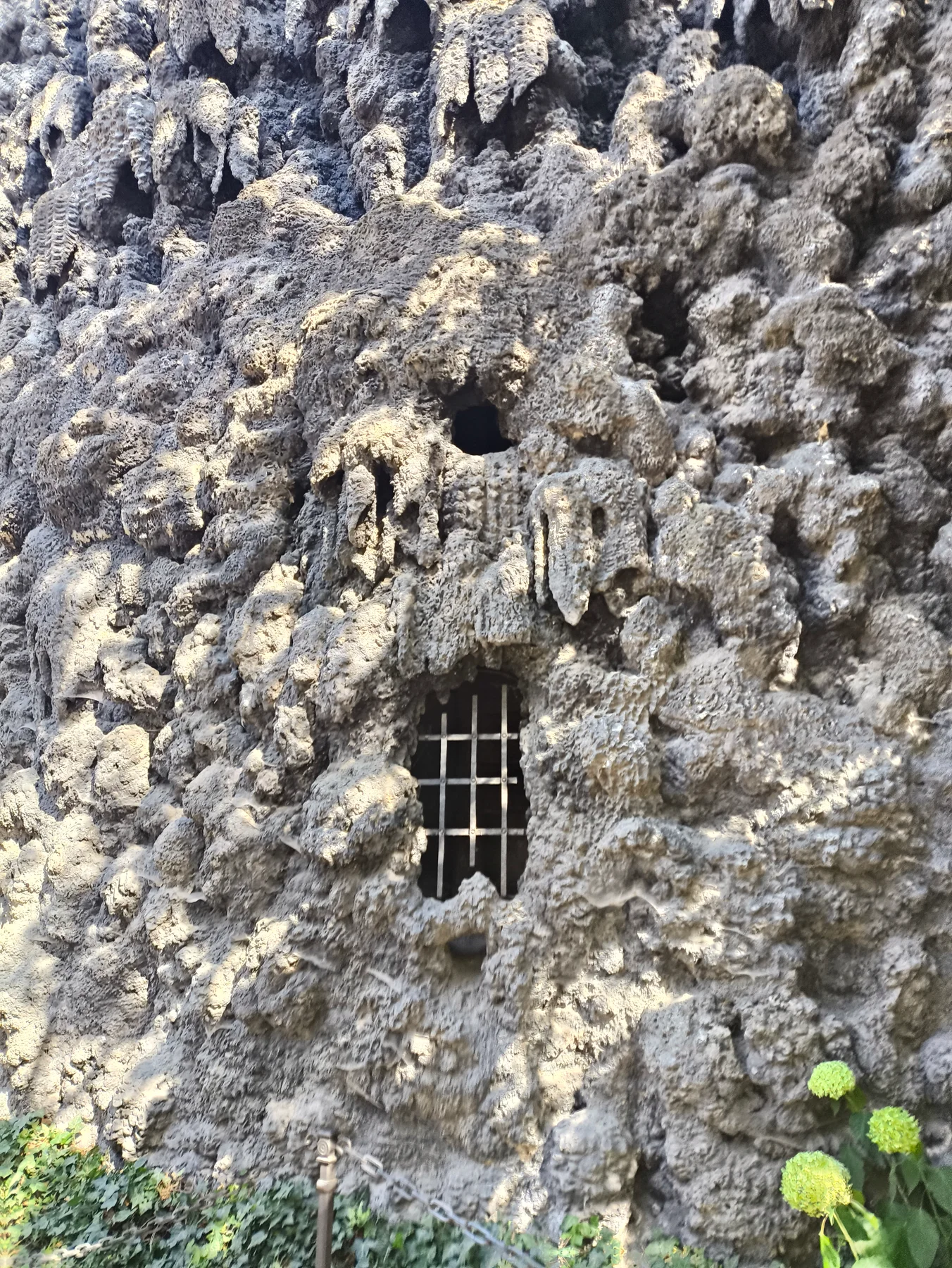
The grotto wall
The rough, dripping forms of this artificial grotto contrast with the neatly ordered garden. Among the shapes, you can pick out hidden faces and animals.
Return towards the centre of the garden, where bronze statues line the main path in front of the sala terrena.
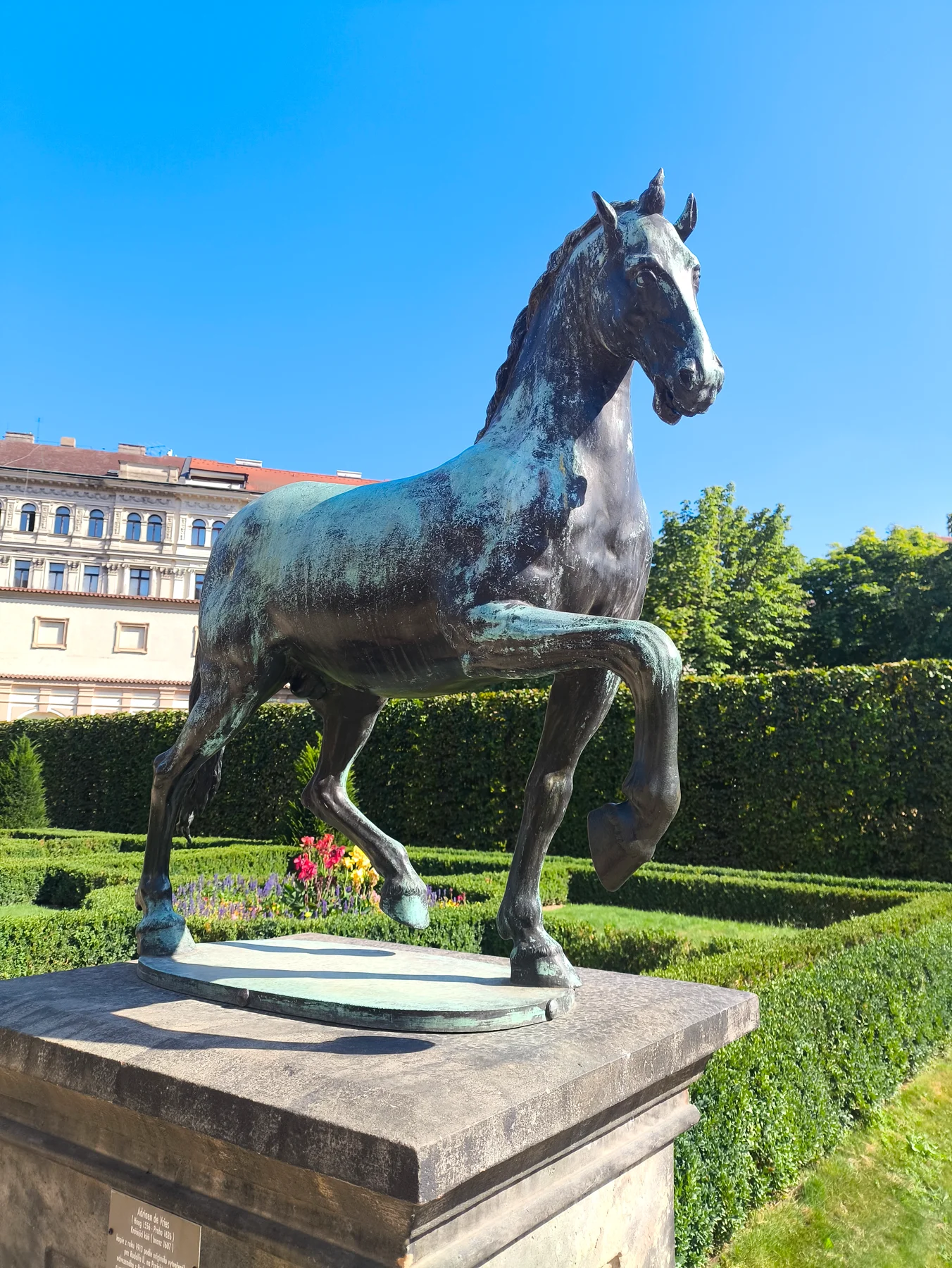
The bronze statues
These dramatic figures of gods, mythological characters and horses are copies of works by Dutch sculptor Adriaen de Vries. Swedish troops carried off the originals in 1648, at the end of the Thirty Years’ War. They remain in Sweden. More than 250 years later, the Wallenstein family commissioned the bronze copies you see here today.
You may also be lucky enough to spot one of the garden’s resident peacocks, some of which are white.
Follow the garden paths towards the large pond, where carp swim beneath the surface and a statue of Hercules stands on the central island.
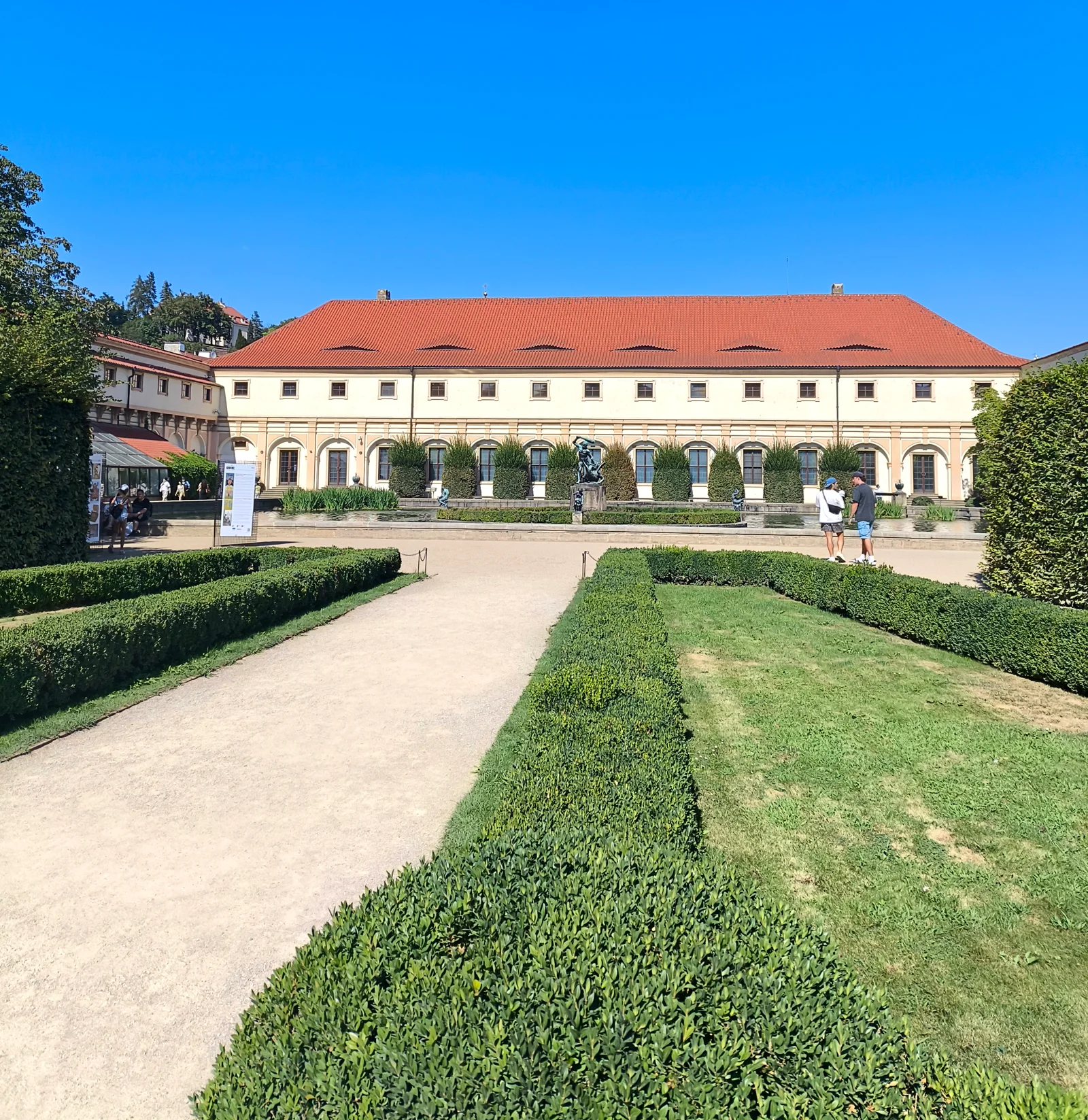
Continue around the pond to the exit on its far side. This brings you out beside Malostranská metro station and the nearby tram stops.
Onward travel
For Old Town, take Metro A towards Depo Hostivař one stop to Staroměstská. To continue to Prague Castle, take tram 22 uphill towards Bílá Hora and get off at Pražský hrad, where you can join our Prague Castle & Hradčany walk.